LCPS Proposes Closing Lucketts Elementary School in FY2028 Budget Discussion
Loudoun County Public Schools (LCPS) presented a potential plan to consolidate Lucketts Elementary School during its FY2028 Budget Work Session on October 27, 2026. Under the approach shown in the presentation, Lucketts students would be reassigned to Waterford Elementary and Ball’s Bluff Elementary. Three other smaller elementary schools—Lincoln, Aldie, and Hamilton—were also identified for possible consolidation.
The proposal is part of an effort that LCPS estimates could save $8.5 million across four schools. The presentation does not establish that any school has been ordered closed. It does not give an implementation date, proposed attendance-zone boundaries, or a school-by-school accounting of the estimated savings.
For Lucketts, the question extends beyond the school budget: what would closing the community’s elementary school mean for children who travel rural roads, families who live within walking distance, and the long-term future of public education in northern Loudoun?
What LCPS Presented on October 27
The three-page Consolidate Schools presentation outlines possible savings, compares six small elementary schools, and identifies four potential consolidations. The slides are reproduced below from the FY2028 budget work-session materials.
An estimated $8.5 million in savings
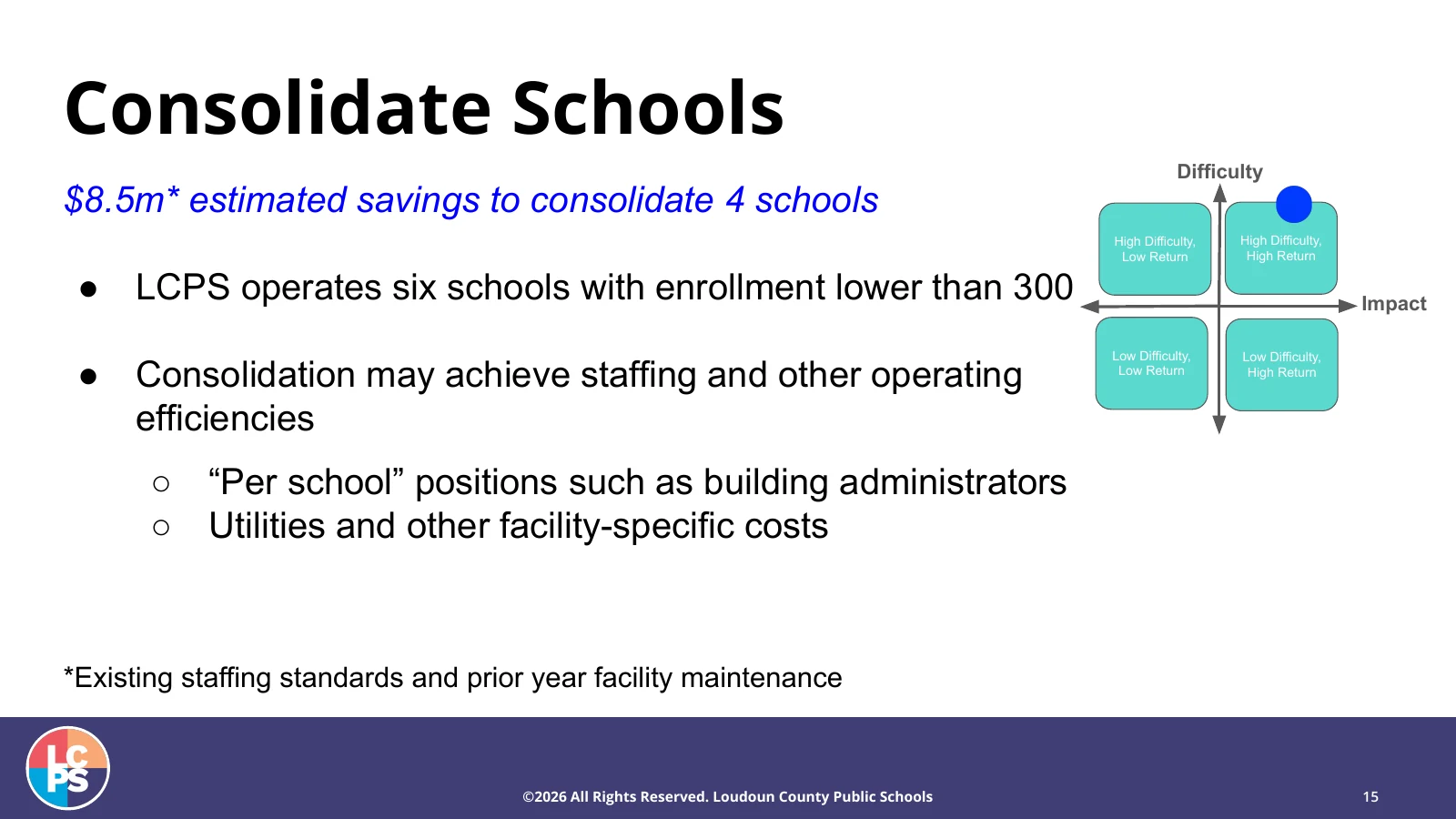
LCPS FY2028 Budget Work Session, October 27, 2026, slide 15. The estimated $8.5 million applies to four potential school consolidations, not Lucketts alone. Source: LCPS.
LCPS identifies six schools enrolling fewer than 300 students and says consolidation may produce efficiencies through school-specific administrative positions, utilities, and facility costs. The slide characterizes the approach as both high difficulty and high return.
The financial distinction is important. Closing an elementary school does not eliminate the cost of educating its students. Teachers, instructional support, transportation, and other services would still be needed at the receiving schools. A meaningful calculation would identify expenses that disappear, expenses that transfer, and new costs caused by consolidation.
Six small schools compared
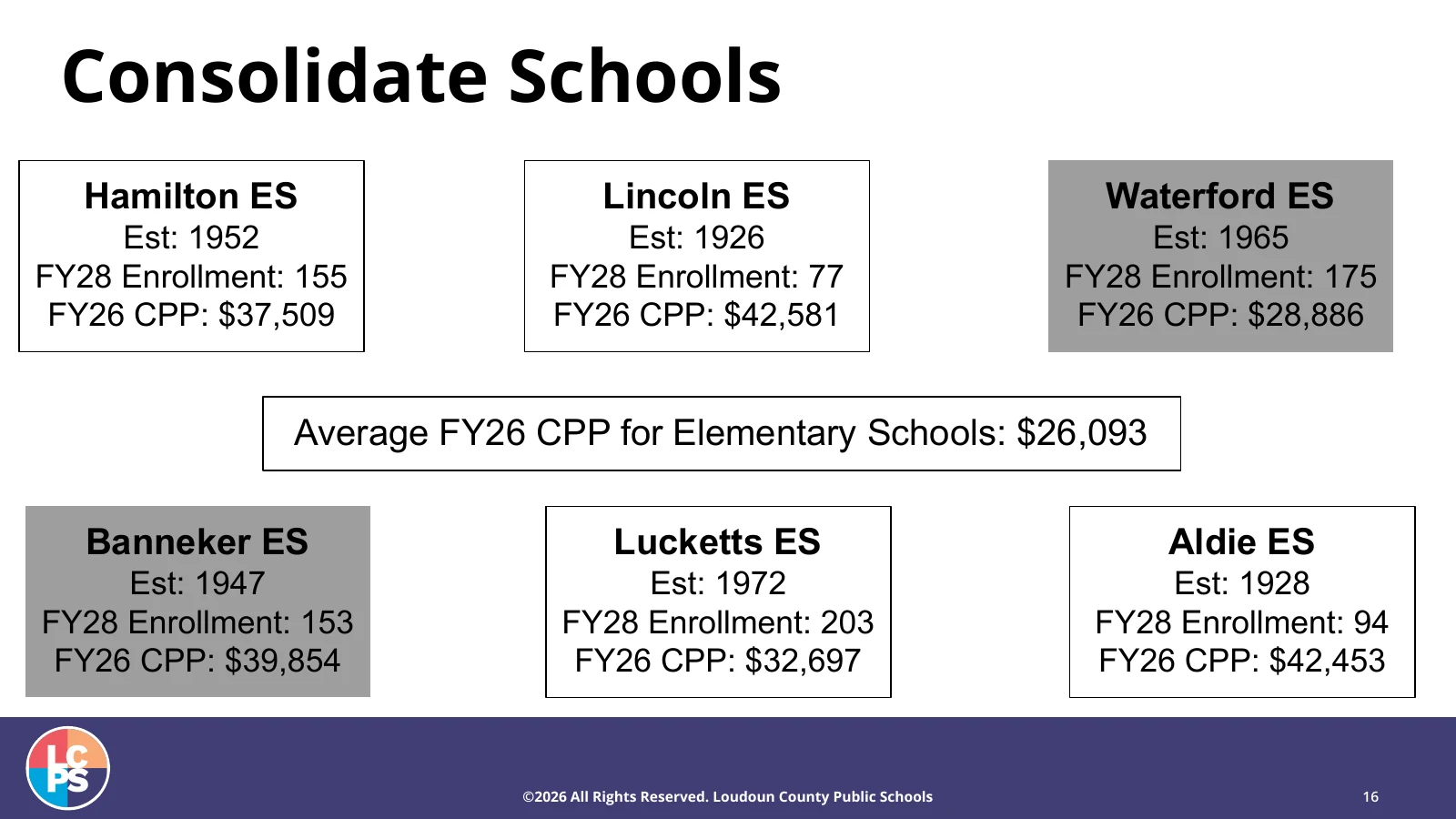
LCPS FY2028 Budget Work Session, October 27, 2026, slide 16. Enrollment is labeled FY2028; cost-per-pupil figures are from FY2026. Source: LCPS.
| Elementary school | FY2028 enrollment shown by LCPS | FY2026 cost per pupil |
|---|---|---|
| Hamilton | 155 | $37,509 |
| Lincoln | 77 | $42,581 |
| Waterford | 175 | $28,886 |
| Banneker | 153 | $39,854 |
| Lucketts | 203 | $32,697 |
| Aldie | 94 | $42,453 |
The presentation lists an FY2026 elementary-school average of $26,093 per pupil. Smaller enrollment generally means fixed costs are spread across fewer students, but the per-pupil figure is not the same as net savings achievable through closing a school.
The 203-student FY2028 projection shown in the work-session slides also differs from the School Board’s December 2025 capital-budget forecast, which projected 219 students in 2027–2028 and 177 in 2028–2029. These may reflect different forecasts or fiscal-year conventions. LCPS should identify the projections and assumptions used in the newer proposal before those numbers are treated as interchangeable.
Four potential school consolidations
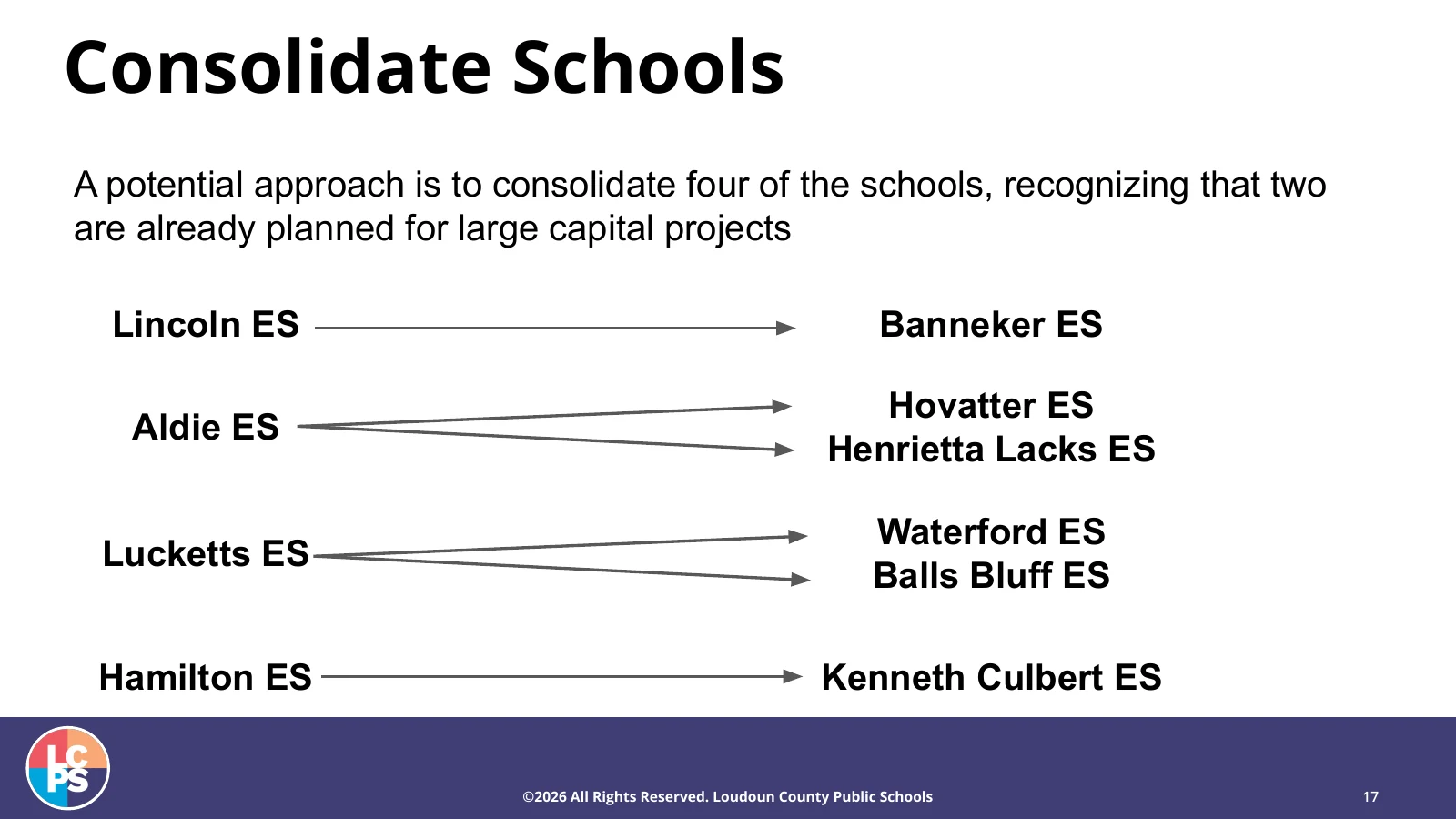
LCPS FY2028 Budget Work Session, October 27, 2026, slide 17. LCPS describes the reassignment scheme as a “potential approach,” not a final boundary or closure decision. Source: LCPS.
| School identified for consolidation | Potential receiving school or schools |
|---|---|
| Lincoln Elementary | Banneker Elementary |
| Aldie Elementary | Hovatter and Henrietta Lacks elementary schools |
| Lucketts Elementary | Waterford and Ball’s Bluff elementary schools |
| Hamilton Elementary | Kenneth W. Culbert Elementary |
LCPS notes that two of the six small schools already have large capital projects planned. Waterford and Banneker appear in the presentation as potential receiving schools, while four others are considered for consolidation. The materials reviewed do not explain exactly how students would be divided between the receiving schools.
What Longer School Trips Could Mean for Lucketts
Unlike compact suburban attendance areas, Lucketts includes widely dispersed homes connected by Route 15 and rural roads. A reassignment may have a significantly different impact depending on where a child lives.
Community-provided point-to-point driving distances from Village Green, one of the area’s largest neighborhoods, illustrate the issue:
| School | Distance from Village Green | Additional distance from current school |
|---|---|---|
| Lucketts Elementary | 3.6 miles | — |
| Waterford Elementary | 8.7 miles | 5.1 miles |
| Richard and Mildred Loving Elementary | 9.5 miles | 5.9 miles |
| Ball’s Bluff Elementary | 10.5 miles | 6.9 miles |
A student sent to Waterford would have a school approximately 2.4 times as far away as Lucketts Elementary; the distance to Ball’s Bluff would be approximately 2.9 times as far. These are community-provided driving distances, not LCPS school-bus route estimates. Actual travel times depend on stops, traffic, road conditions, and the final attendance boundaries.
The change could be particularly consequential for families living in the affordable housing community directly across the road from Lucketts Elementary. Their current school is immediately nearby. The reported driving distance would become approximately 5.5 miles to Waterford or 7 miles to Ball’s Bluff. That could complicate attendance at conferences, school activities, or unexpected early pickups for families without reliable private transportation.
The proposed selection of Ball’s Bluff also invites a closer look at alternatives. Richard and Mildred Loving Elementary, at 800 N. King Street in Leesburg, is approximately one mile closer to Village Green than Ball’s Bluff. That does not establish that Loving is a better receiving school—capacity, boundaries, programs, and routing all matter—but LCPS should explain which alternatives it considered and why.
No projected bus travel times, proposed neighborhood assignments, or school-specific transportation costs appear in the three-slide presentation.
The Adopted Capital Plan Assumed Continued Investment
The School Board’s December 16, 2025 FY2027–FY2032 capital budget identifies continued facility improvements at Lucketts Elementary, including a walking track and unified communications system in FY2027. It also describes capital projects at Waterford and Banneker, two of the proposed receiving schools.
The capital plan identifies $20.09 million in prior-year funding for Waterford’s renovation and addition, including classrooms and other improvements. A planned classroom addition would increase Waterford’s capacity to 284 students after removal of modular classrooms, according to the plan’s Western Loudoun enrollment table. The corresponding capital budget lists $48.3 million in prior-year funding for Banneker’s renovation and addition.
These projects were included in plans adopted before the October 2026 consolidation presentation. Their existence does not prove the projects were intended to support school closures. Likewise, planned capital spending is not the same thing as funds already expended. Nevertheless, the School Board should explain how the newer proposal reconciles with its recent facilities planning and spending priorities.
Lucketts Is a Fully Accredited School
The Virginia Department of Education’s 2026 School Summary Report lists Lucketts Elementary as Fully Accredited, with a score of 88.55 and a performance category of Meets Expectations. It has no federal identification status under the state framework.
Waterford is also fully accredited and is rated Distinguished with a score of 95.54. Ball’s Bluff is fully accredited, rated Meets Expectations, and scored 89.23.
Lucketts’s mathematics mastery index (99.13) is higher than those reported for Waterford (98.37) and Ball’s Bluff (95.12). The reports also show different student-group performance and different overall scoring weights, so these comparisons should not be treated as proof that one school is categorically better than another.
What the state reports do establish is that Lucketts meets Virginia’s accreditation standards. The consolidation proposal should therefore be examined on its actual financial and planning merits, without suggesting that closure is a response to a state accreditation failure.
What Remains Unanswered
The work-session presentation raises several questions that should be resolved before a proposal of this magnitude moves forward:
- School-specific savings: What is the projected annual net savings from closing Lucketts after staffing, transportation, transition, and receiving-school costs?
- Attendance boundaries: Which parts of Lucketts would attend Waterford, and which would attend Ball’s Bluff?
- Transportation: How would routes, ride times, pickup times, and costs change—particularly for students using Route 15?
- Equity and access: How would the change affect students living across the road from their current school, including families with limited transportation options?
- Alternative schools: Was Richard and Mildred Loving Elementary considered, and what criteria determined the proposed receiving schools?
- Capital planning: Which Lucketts projects would proceed, which would be canceled, and what would happen to the building and property?
- Public process: What analyses, hearings, community engagement, and School Board actions would occur before any closure decision?
What Happens Next?
As of October 27, 2026, the three slides reviewed for this story present a potential consolidation approach. They do not document a final closure vote or establish a date for implementation. The timing and public engagement process require confirmation from LCPS and the School Board.
The proposal is significant enough that the underlying figures and assumptions should be made public well before any decision. Lucketts families should not have to evaluate an $8.5 million countywide estimate without knowing the actual savings and consequences of closing their own school.
A Rural Community Deserves a Complete Accounting
School enrollment changes, and responsible management of public resources is essential. LCPS has a legitimate obligation to examine operating costs and the use of its facilities.
But closing Lucketts Elementary would affect more than an operating budget. It could move children substantially farther from their homes, change families’ access to school activities, and remove a longstanding community institution from northern Loudoun.
Before advancing the proposal, LCPS should explain the school-specific savings, alternatives, transportation impacts, and community consequences in a form that residents can review and challenge. For Lucketts, that is the minimum standard of transparency such a decision deserves.
Sources and Documentation
- LCPS, Consolidate Schools, FY2028 Budget Work Session, October 27, 2026, slides 15–17 — primary presentation underlying this article; embedded slides reproduced above.
- LCPS, School Board Adopted FY2027–FY2032 Capital Budget and FY2033–FY2056 Capital Projects Forecast — Adopted December 16, 2025. See pp. 13–15 for capital funding and long-range school forecasts; pp. 44–46 for planned improvements; pp. 53 and 59 for Banneker and Waterford projects; and pp. 252 and 292 for elementary enrollment projections.
- Virginia Department of Education, Lucketts Elementary School Summary Report 2026 — accreditation, mastery, and absenteeism indicators.
- Virginia Department of Education, Waterford Elementary School Summary Report 2026 — accreditation and mastery indicators.
- Virginia Department of Education, Ball’s Bluff Elementary School Summary Report 2026 — accreditation and mastery indicators.
- Community-provided driving distances for Village Green and housing immediately across from Lucketts Elementary, supplied October 27, 2026. These are not official LCPS bus-route measurements.